
EASTLIFT
Product description
Development History of Spider Lifts
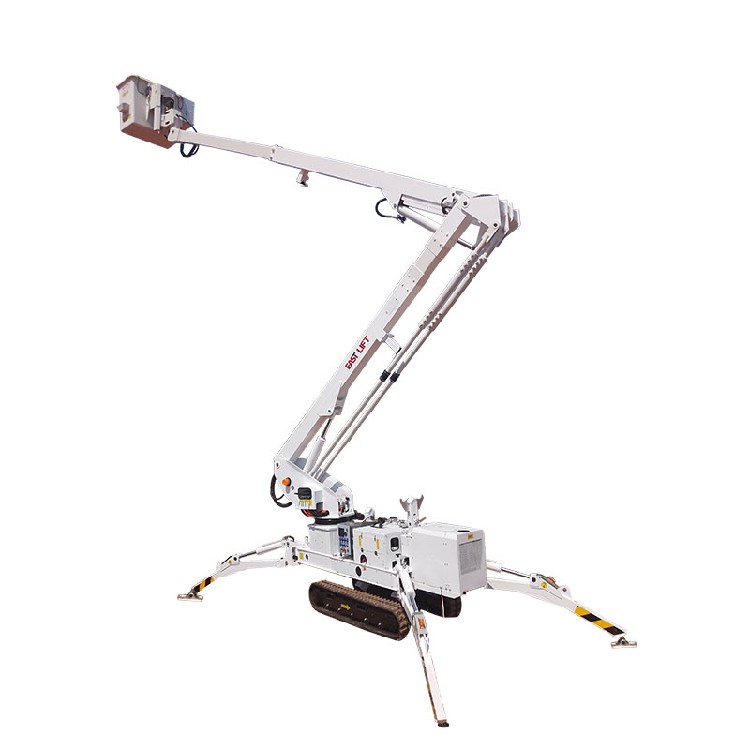
Spider lifts (spider-type aerial work platforms) are compact aerial equipment designed specifically for narrow spaces, indoor, and precision scenarios. Their development can be clearly divided into four stages: initial exploration, technological formation, global popularization, and intelligent upgrading. They have evolved from niche specialized equipment to an important category in the aerial work platform industry.
I. Origin and Exploration Period (1970s): Concept Birth and First-Generation Products
Core Background
Traditional scaffolding and conventional boom lifts struggle to access narrow, high-clearance spaces with strict floor protection requirements, such as shopping mall atriums, churches, and hotel lobbies. The market demanded more flexible aerial solutions.
Key Breakthroughs
In the late 1970s, Denmark’s Falck Schmidt (FACLON) first proposed the “spider-type” design concept, featuring four independently extendable outriggers, a compact tracked chassis, and multi‑section articulated booms to ensure stable operation in confined spaces.
In 1979, Italy’s Easylift launched the world’s first commercial spider lift, mainly used for indoor maintenance and decoration, with a working height of approximately 10–15 meters and primarily hydraulic drive.
Technical Features
Simple structure, small load capacity (≤100 kg), limited height, only for basic indoor applications, with no electrification or intelligent functions.
II. Technological Formation and European Dominance (1980s–1990s): Performance Improvement and Category Establishment
Market Expansion
Europe became the technological center. Brands including Italy’s Palazzani (mass production from the 1980s), Germany’s Teupen, and France’s Haulotte entered the market. Applications expanded from indoors to outdoor complex terrain, venues, industrial maintenance, and other scenarios.
Technological Upgrades
- Boom system: upgraded from single‑section articulation to a combination of multi‑section telescopic and articulated booms; working height exceeded 20 meters, with greatly expanded working radius.
- Chassis and outriggers: non‑marking rubber tracks to protect indoor floors; independent outrigger leveling for slopes and uneven ground.
- Power: hydraulic drive retained; small diesel engines introduced for both indoor and outdoor use.
- Industry Positioning
- Established core advantages of compactness, light weight, high passability, and strong stability, becoming an important supplement to traditional aerial equipment.
III. Global Popularization and Rise of China (2000s–2010s): Market Boom and Localization
Global Expansion
Mature markets in Europe and America; products entered the Middle East, Asia‑Pacific, and Latin America. Applications covered construction, property management, electric power, airports, exhibitions, etc. Working height reached 30–40 meters, load capacity increased to 200–300 kg.
Development in China
- Before 2000: fully dependent on imports, high prices, extremely low ownership.
- 2000–2010: domestic manufacturers (such as Sinoboom, Dingli, and Yunxiang) launched independent R&D, broke through core technologies in hydraulics, booms, and outrigger control, and released 10–25 m domestic models. Prices fell and the market grew rapidly.
- After 2010: China became the world’s largest manufacturer and consumer market. Domestic equipment gained obvious cost‑performance advantages, with growing export volumes.
- Power Innovation
- Lithium‑ion power introduced, achieving zero emissions and low noise indoors, suitable for sensitive environments such as hospitals, data centers, and commercial complexes.
IV. Intelligent and High-End Period (From the 2010s to Present): Technological Iteration and Scenario Deepening
Breakthroughs in Performance Limits
- Working height: top models (e.g., Palazzani XTJ52) reach 52 meters, working radius exceeds 20 meters, load capacity stably 230–300 kg, covering most high‑altitude scenarios.
- Chassis: omnidirectional movement and zero‑radius turning widely adopted, further improving passability and flexibility.
- Intelligent Upgrades
- Electronic control: PLC + touchscreen operation, supporting fault diagnosis, parameter setting, one‑key leveling, and outrigger interlock, greatly improving safety.
- Intelligent monitoring: equipped with inclination, pressure, and position sensors; real‑time attitude and load monitoring, automatic early warning/lockout in case of overload.
- New energy: pure lithium and diesel‑electric hybrid become mainstream, with all‑day working range and compliance with low‑carbon environmental requirements.
- Chinese Technological Breakthroughs
- Zoomlion, XCMG, Sany, and others launched high‑end lithium spider lifts of 27–40 meters (e.g., Zoomlion ZX27AE), matching international brands in performance and accelerating domestic substitution.
V. Development Trends (Next 3–5 Years)
- Higher, farther, stronger: working height toward 60 meters+, wider use of lightweight, high‑strength materials (special steel, carbon fiber).
- Full electrification: pure electric and hydrogen fuel cells gradually replacing diesel engines for zero emissions, long endurance, and fast charging.
- Deep intelligence: automatic obstacle avoidance, path planning, remote control, and digital twin as standard features, reducing operation difficulty and improving safety.
- Scenario customization: special models and attachments (platforms, grabs, welding tools) for photovoltaics, wind power, tunnels, large venues, and other segments.