
The Broad Prospects of Mast Slewing Elevators
Product description
The Broad Prospects of Mast Slewing Elevators
Amid the increasingly segmented categories of aerial work equipment and increasingly refined scene-based demands, mast sleeve-type elevators have stood out from numerous aerial devices with their unique structural design and performance advantages, becoming an essential equipment for narrow spaces and refined aerial work scenarios.Unlike the conventional vertical operation of scissor lifts and the large-span aerial operation of boom lifts, mast sleeve-type elevators feature a compact body, multi-stage sleeve lifting, stable and quiet operation, and extremely small space occupation as their core highlights, which precisely fill the gap in aerial work equipment for narrow scenarios.With the rising demand for refined operations in downstream industries, the market recognition of this equipment continues to grow, and its development prospects are very broad.
At present, due to the stricter supervision of work safety and the persistently high labor costs, traditional scaffolding and simple climbing tools are gradually being phased out, and aerial work equipment is transforming towards lightweight, refined and scenario-oriented development.With its strong scene adaptability and high cost performance, mast sleeve-type elevators have rapidly covered many fields and become a high-quality category in the segmented track of aerial work equipment.
I. Compact structure, enabling operation in narrow spaces
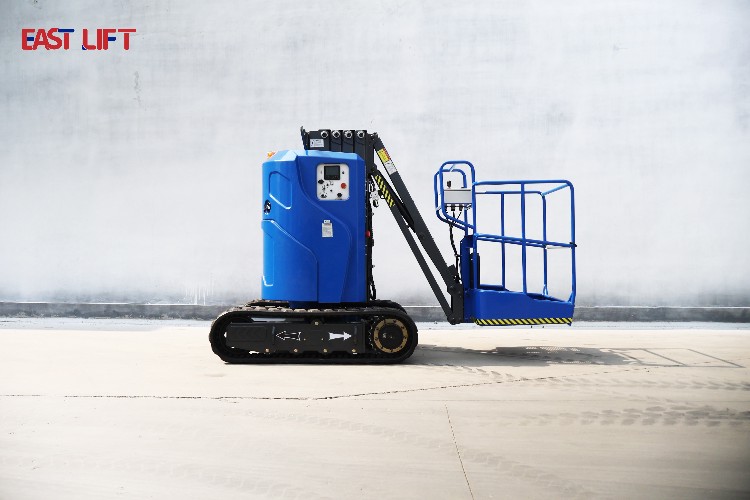
The most prominent advantage of the mast sleeve-type elevator is its small footprint. With a narrow body, it features flexible steering and can move freely in narrow spaces such as stairwells, corridors and elevator shafts.This is an operational advantage that is difficult to achieve with scissor lifts and boom lifts. Moreover, it does not require a large working area. Even in crowded indoor environments, it can park flexibly and lift smoothly, perfectly solving the problem that traditional equipment cannot enter narrow spaces and is restricted in operation, making it the exclusive aerial work equipment for such scenarios.
II. Stable lifting and lowering, ensuring high operational safety and precision
The mast sleeve-type elevator adopts aluminum alloy masts driven by hydraulic or electric power. The lifting process is stable and free of shaking, without causing interference to the working environment and surrounding equipment, especially in high-precision scenarios such as the maintenance of shopping mall lighting and precision equipment. At the same time, the equipment operates with extremely low noise and features zero emissions and no pollution, making it highly suitable for places with strict requirements for quietness and environmental protection, such as hospitals, schools and office buildings. Its operating experience far exceeds that of traditional climbing equipment.
III. Simple operation, enabling work by a single person
The mast sleeve-type elevator features a simple and easy-to-understand control logic, equipped with dual control modes: platform control panel and ground remote control.After brief training, operators can quickly get started.The equipment requires no assembly or erection and can be put into use immediately upon arrival at the site, eliminating the cumbersome process of scaffolding disassembly and assembly.A single person can complete a full range of tasks such as working at height, inspection, maintenance and installation.This greatly saves labor and time costs, while significantly improving work efficiency.
IV. Complete safety configurations
Standard mast sleeve-type elevators are equipped with comprehensive safety protection devices, including overload protection, emergency stop button, emergency manual lowering, self-locking guardrail, tilt alarm and other functions, which comprehensively protect the safety of operators.The fuselage is made of high-strength aluminum alloy, which is corrosion-resistant, wear-resistant and highly stable.The equipment is manufactured in strict accordance with industry safety standards, fully complying with the current supervision of aerial work safety, and the risks of daily operation are extremely low.
Conclusion
In summary, as a specialized tool for aerial work in confined spaces, the mast sleeve-type elevator boasts core advantages including a compact structure, stable operation, convenient control, safety, environmental friendliness and high cost-effectiveness. It precisely meets the rigid demands of segmented scenarios and firmly holds a mainstream position in the refined aerial work market.Driven by multiple factors such as the upgrading of refined scenarios, the iteration of electrification technologies, the popularization of the rental market and policy safety supervision, the market demand for this equipment will continue to rise, with very broad development prospects.