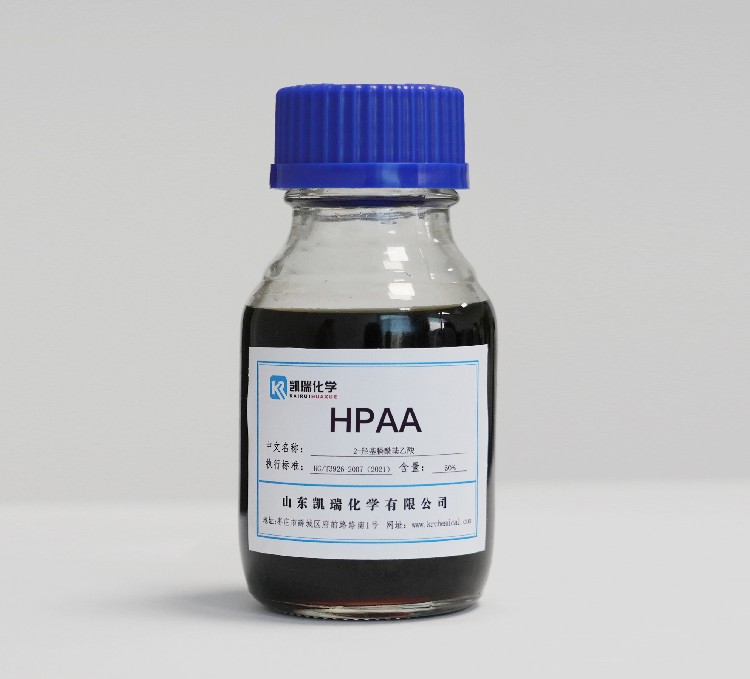
2-Hydroxy Phosphonoacetic Acid (HPAA) 23783-26-8
Product description
2-Hydroxyphosphonoacetic Acid (HPAA) is a versatile organophosphonate whose applications are centered on its strong chelating and corrosion inhibition properties. While its primary and most established use is in industrial water treatment, emerging research and applications demonstrate its growing value in advanced manufacturing and energy storage.
Core Applications: Industrial Water Treatment & Corrosion Control
This is the largest and most traditional market for HPAA. It excels as a cathodic corrosion inhibitor, particularly for protecting mild steel in challenging environments .
Superior Corrosion Inhibition: HPAA forms a protective film on metal surfaces by chelating with metal ions like Zn²⁺ at cathodic sites. Its effectiveness is reported to be 5-8 times higher than common phosphonates like HEDP and EDTMP for mild steel corrosion inhibition . It is highly valued in all-organic cooling water formulations and can serve as a replacement for molybdate inhibitors in certain applications .
Effective Scale Inhibition: HPAA provides good inhibition against calcium carbonate (calcite) scale . It is often blended with other strong scale inhibitors, such as PBTC, to provide a balance of corrosion and scale control that neither can achieve alone .
Zinc Compatibility: HPAA has excellent compatibility with zinc ions, making it useful in formulations that use zinc for enhanced corrosion protection .
High-Temperature Performance: The compound demonstrates high thermal stability, remaining effective in systems operating up to approximately 200°C .
Advanced & Emerging Applications
Beyond water treatment, HPAA is finding a role in several specialized fields due to its unique chemical properties.
Semiconductor Manufacturing (CMP): Recent research indicates HPAA is a promising chelating agent for chemical mechanical polishing (CMP) in semiconductor fabrication. In this role, it helps to selectively dissolve and remove titanium barrier layers, a critical step in creating reliable 3D integrated circuit packaging. Its relatively high biodegradability provides an environmental advantage over other chelating agents in this process .
Mineral Processing: HPAA has been explored as a high-efficiency, environmentally friendly depressant in the flotation process for copper ore. It can selectively inhibit unwanted silicate minerals (like lizardite) while allowing the desired copper-bearing mineral (chalcopyrite) to be recovered, improving both recovery and concentrate grade .
Energy Storage: In the field of battery technology, HPAA has been used to create a protective layer on zinc anodes in aqueous batteries. This HPAA layer successfully suppresses the formation of detrimental zinc dendrites and side reactions, leading to significantly longer battery cycle life .
In summary, HPAA is a high-performance specialty chemical serving both mature and cutting-edge industries. Its proven efficacy as a corrosion inhibitor and its growing role in advanced technologies highlight its versatility.
Recommended products