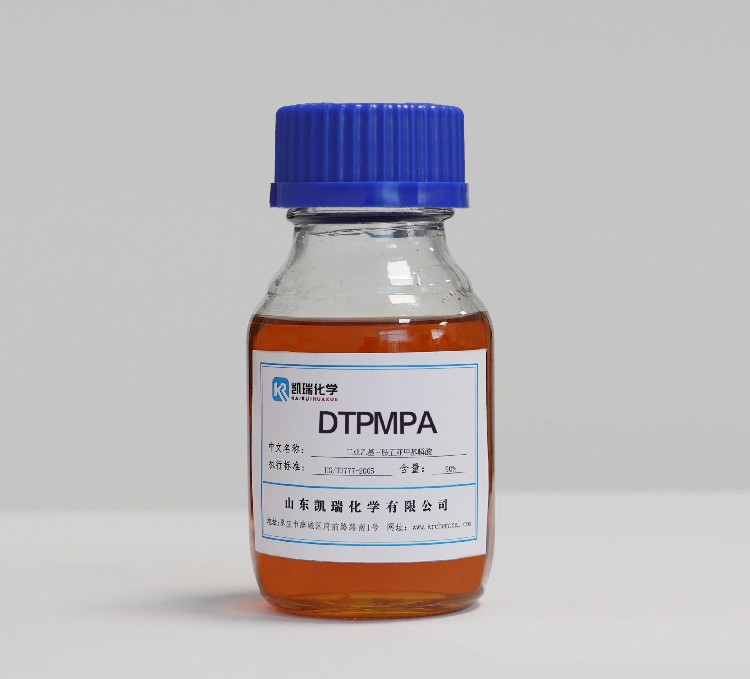
Diethylene Triamine Penta (Methylene Phosphonic Acid) (DTPMPA)
Product description
Diethylene Triamine Penta (Methylene Phosphonic Acid), commonly known as DTPMPA, is a highly effective, versatile organic phosphonate. Its primary strengths lie in its excellent scale and corrosion inhibition, exceptional thermal stability, and strong chelating ability, making it a key component in various industrial applications.
⚙️ Core Functions & Mechanisms
DTPMPA's effectiveness comes from its molecular structure, which allows it to interact strongly with metal ions. Its key functions include:
Scale Inhibition: It prevents the formation of mineral scales like calcium carbonate and sulfate by a mechanism called threshold inhibition. It works at low concentrations to interfere with crystal growth, keeping scale-forming salts dispersed in the water.
Corrosion Inhibition: By forming a protective film on metal surfaces, it helps reduce corrosion in industrial systems.
Chelation & Dispersion: DTPMPA is an excellent chelating agent that can bind to metal ions (e.g., iron, calcium, magnesium) in a stoichiometric ratio. It also acts as a dispersant for solid particles. A notable feature is that it can be used effectively without the need for additional dispersants in some formulations.
Exceptional Thermal Stability: It maintains its performance even at very high temperatures (over 210°C) and in alkaline environments, which is often superior to other organic phosphonates.
🏭 Major Application Areas
DTPMPA is widely used across multiple industries. Its main applications are summarized below:
Application Area Specific Uses
Water Treatment Scale and corrosion inhibitor in cooling water systems, boiler water, and oilfield injection water, especially effective in alkaline conditions without pH adjustment.
Textile & Pulp Chelating agent to control metal ions, and a stabilizer for peroxide bleaches, particularly effective at high temperatures.
Other Industries Pigment dispersant, concrete additive, chelating agent in electroplating and metal cleaning, and as a stabilizer for oxidizing biocides.
⚠️ Usage & Handling
Recommended Dosage: As a scale inhibitor, typical usage concentrations are 1-30 mg/L. For cleaning applications, a much higher dose of 1000-2000 mg/L is often used. It is commonly used in combination with polycarboxylate scale inhibitors for enhanced performance.
Safety: DTPMPA is acidic and can be irritating. When handling, avoid contact with eyes and skin, and use appropriate protective equipment. In case of contact, rinse immediately with plenty of water.
Storage: It should be stored in a cool, dry, and ventilated indoor area, away from direct sunlight and moisture. The typical shelf life is around ten to twelve months.
Recommended products