Oil-water separator, restaurant oil-water separation equipment, kitchen oily wastewater treatment, oil removal facility
Product description
Instruction Manual of Lvgu Tongtai Environmental Protection Stainless Steel Oil-Water Separator
1. Product Overview
The stainless steel oil-water separator produced by Lvgu Tongtai Environmental Protection is a special separation equipment developed for the treatment of catering and industrial oily wastewater. It realizes three-phase separation of oil, water and residue by utilizing the principle of density difference between oil and water, and can complete the treatment process without additional power. Corresponding specifications and models can be selected according to different scenario requirements, which can effectively reduce the oil concentration of drainage, avoid oil pollution blocking drainage pipelines, and meet environmental protection emission requirements. The main body of the whole series of products is made of 304 stainless steel, which has good corrosion resistance and aging resistance, long service life and easy maintenance.
At present, the whole series of products are divided into three categories: non-powered advection oil-water separator, forced discharge oil-water separator and fully automatic oil-water separator, which can adapt to different scale usage scenarios from small catering stores to large commercial complexes and industrial production sites.
2. Product Technical Parameters
Table 1. Core Technical Parameters of Lvgu Tongtai Stainless Steel Oil-Water Separator
| Main Material | 304 Stainless Steel |
| Applicable Wastewater Type | Catering oily wastewater, light industrial oily wastewater |
| Separation Efficiency | ≥95% |
| Working Temperature Range | 0℃~80℃ |
| Protection Grade | IP55 |
| Design Service Life | ≥10 years |
3. Product Category Introduction
3.1 Non-powered Advection Oil-Water Separator
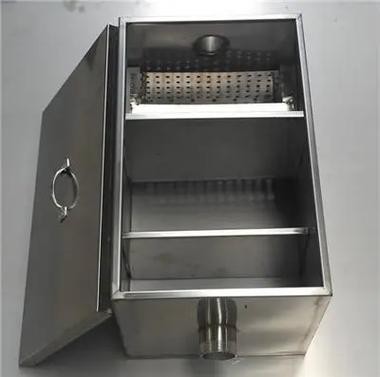
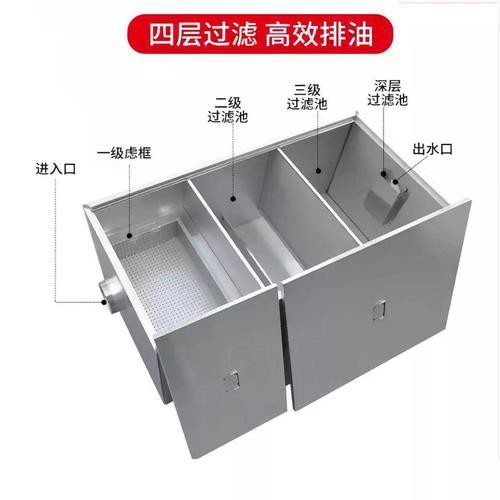
The non-powered advection oil-water separator is the most cost-effective product in the series, which does not need to be connected to power supply during operation, and completely relies on the physical principle of oil-water density difference to realize separation. The equipment is designed with multi-stage advection structure, and the wastewater flows slowly in the tank, so that the oil droplets with smaller particle size have sufficient time to float up to the oil collection layer, and the solid residue is intercepted in the slag collection area at the front end of the equipment. This product is suitable for small catering stores, individual restaurants, small canteens and other scenarios with small wastewater discharge and low operation and maintenance investment budget. It has the advantages of no energy consumption, low noise, simple installation and no need for special personnel to take charge of operation.
The treatment capacity of this series of products ranges from 1 ton per hour to 10 tons per hour, and the size can be customized according to the installation space of users. The inlet and outlet adopt standard flange connection, which can be directly connected with the existing drainage pipeline. There is a visible oil level observation port on the top of the equipment, so that the operator can grasp the oil accumulation in real time and arrange the cleaning work reasonably.
3.2 Forced Discharge Oil-Water Separator
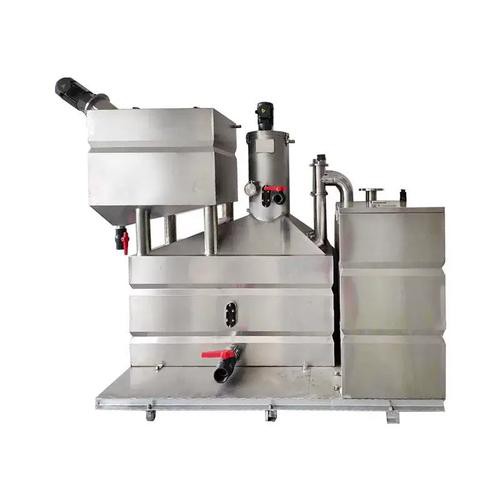
The forced discharge oil-water separator adds an integrated lifting pump set on the basis of the non-powered model, which can lift the treated wastewater to the designated drainage pipe network or secondary treatment equipment, solving the problem that the drainage site is lower than the municipal pipe network and cannot discharge by gravity. The equipment is equipped with an automatic liquid level control system. When the water level in the tank reaches the set height, the lifting pump starts automatically, and when the water level drops to the set low level, the pump stops automatically, which does not need manual operation. This product is suitable for medium-sized catering stores, chain restaurants, medium-sized enterprise canteens, underground business districts and other scenarios that need to lift drainage.
The lifting pump set adopts cutting type impeller, which can pass small particle impurities, effectively avoiding the blockage of the pump body caused by residual food residues. The equipment is also equipped with an overload protection device for the pump body. When the pump is overloaded or blocked, the power supply will be automatically cut off and an alarm will be given to avoid burning the motor. The treatment capacity of this series of products ranges from 5 tons per hour to 30 tons per hour, and the lift of the lifting pump can be selected from 5 meters to 20 meters according to the actual needs of users.
3.3 Fully Automatic Oil-Water Separator
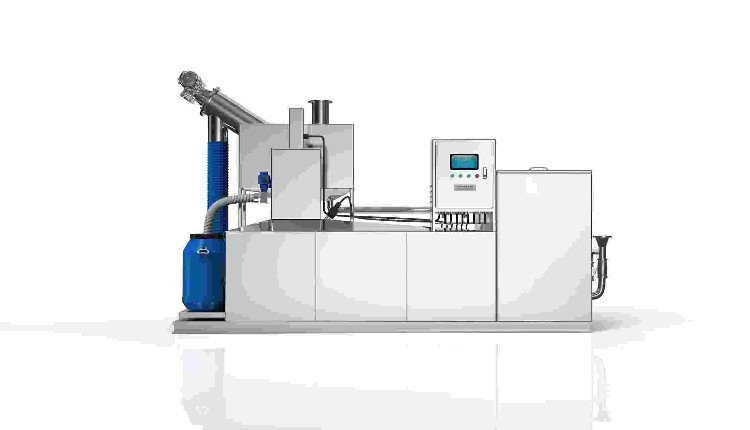
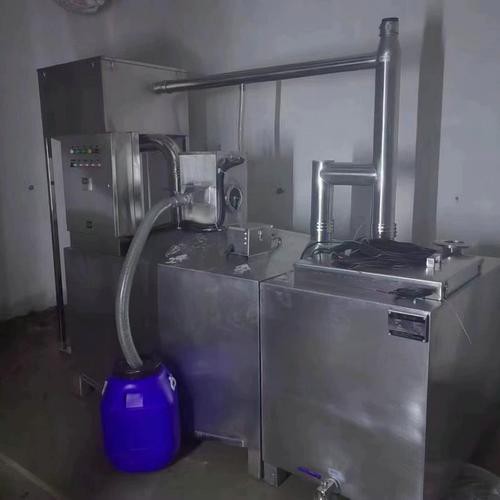
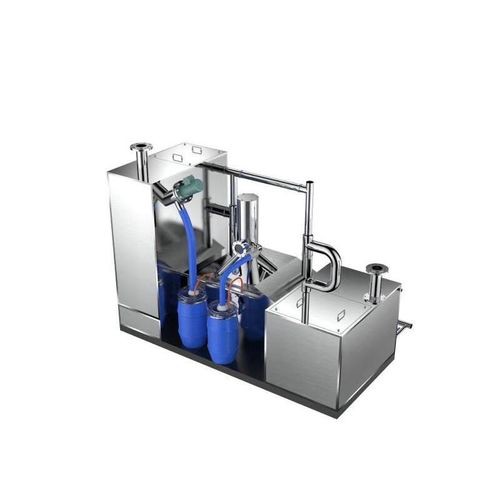
The fully automatic oil-water separator is the highest configuration product in the series, integrating automatic slag discharge, automatic oil scraping, constant temperature heating and remote monitoring functions, which can realize fully automatic operation without personnel on duty for a long time. The equipment is equipped with a screw slag discharge device at the front end, which can automatically discharge the filtered solid residues to the slag collection barrel, avoiding the problem of residue fermentation and odor caused by long-term accumulation in the tank. The oil scraping device operates periodically according to the set program, scraping the floating oil on the liquid surface to the oil collection tank, and then discharging it through the oil discharge valve. The constant temperature heating system can maintain the water temperature in the tank at 20℃~30℃ in low temperature environment, avoiding the solidification of animal oil and fat, and ensuring the separation efficiency.
This product is suitable for large commercial complexes, star hotels, large industrial parks, central kitchens and other scenarios with large wastewater discharge and high requirements for operation and management efficiency. The equipment is equipped with a remote communication module, which can transmit the operation status, fault information, oil accumulation and other data to the user management platform in real time, so that the manager can grasp the operation situation of the equipment without going to the site. The treatment capacity of this series of products ranges from 10 tons per hour to 100 tons per hour, and customized functions such as oil content online monitoring and data uploading to the environmental protection supervision platform can be added according to user needs.
4. Working Principle and Operation Process
4.1 Working Principle of Non-powered Advection Oil-Water Separator
After the oily wastewater enters the equipment, it first passes through the slag interception basket, and the solid residues with particle size larger than 5mm are intercepted in the basket. The wastewater after slag removal flows into the advection separation area. In the process of slow flow, the oil droplets with density less than water gradually float up to the liquid surface, and the water with higher density sinks to the lower part of the tank. The wastewater after separation flows out through the water outlet at the lower part of the rear end of the equipment, and the floating oil is stored in the oil collection area at the upper part of the tank, and is discharged regularly through the oil discharge valve.
1. Before use, check whether the slag interception basket is placed correctly and whether the oil discharge valve is closed;
2. Connect the equipment inlet with the kitchen drainage outlet, and connect the outlet with the municipal drainage pipeline;
3. After the wastewater enters the equipment, it automatically completes the separation process, and regularly takes out the slag interception basket to clean the residues, and opens the oil discharge valve to discharge the accumulated oil.
4.2 Working Principle and Operation Process of Forced Discharge Oil-Water Separator
The separation process of the forced discharge type is consistent with that of the non-powered type. The difference is that after the separation is completed, the wastewater enters the lifting pump chamber. When the liquid level reaches the start-up height of the pump, the lifting pump starts automatically to discharge the treated wastewater to the designated location. The equipment is equipped with a dual pump system for users to choose. When one pump fails, the other pump can automatically start to ensure the normal operation of drainage.
1. Before installation, connect the equipment power supply and check whether the liquid level sensor and pump operate normally;
2. After the equipment is put into operation, it automatically operates according to the liquid level signal, and the operator only needs to clean the slag and accumulated oil regularly;
3. When the equipment gives an alarm, check the pump operation status and whether the pipeline is blocked in time, and eliminate the fault.
4.3 Working Principle and Operation Process of Fully Automatic Oil-Water Separator
After the oily wastewater enters the fully automatic equipment, it first passes through the slag discharge device, and the solid residues are filtered and automatically discharged to the slag collection barrel. The wastewater after slag removal enters the heating separation area, and the constant temperature heating system keeps the water temperature in the optimal range for oil-water separation. The floating oil on the liquid surface is scraped to the oil collection tank by the scraper running periodically, and is discharged automatically or manually. The treated wastewater is discharged by gravity or lifted by a lifting pump according to the site conditions.
1. After the equipment is connected to the power supply, set the automatic operation program, and the oil scraping device, heating device and slag discharge device operate automatically according to the set cycle;
2. After the oily wastewater enters the equipment, it automatically completes the whole process of solid residue filtration, oil-water separation, oil scraping and collection, and automatic slag discharge, without manual daily operation;
3. Set the heating temperature to avoid grease solidification in low temperature environment and ensure the separation effect.
5. Maintenance and Precautions
1. The internal residue and accumulated oil of the equipment should be cleaned regularly. It is recommended to clean the non-powered type once every 3~7 days, and the fully automatic type should be inspected and cleaned once every 1~3 months to avoid residue accumulation affecting the separation effect;
2. High temperature wastewater shall not be directly discharged into the equipment, and the inlet water temperature shall not exceed the maximum working temperature calibrated by the product, so as to avoid damaging the stainless steel tank or seals;
3. It is forbidden to discharge inflammable, explosive, strong acid and strong alkali substances into the equipment to avoid safety accidents or corrosion of the equipment;
4. For forced discharge and fully automatic products, the electrical components shall be checked once a month to see if the wiring terminals are loose and the grounding protection is effective. The power supply must be cut off when the equipment is shut down for a long time;
5. When the ambient temperature is lower than 0℃ in winter, the accumulated water in the equipment must be drained to avoid freezing and cracking the tank and pipeline.
Note:The equipment maintenance must be carried out after disconnecting the power supply. The operation in the confined space must comply with the safety operation specifications, implement ventilation and protection measures, and it is strictly forbidden for a single person to enter the equipment tank for operation.
6. After-sales Service
1. This product provides [to be supplemented] months of warranty service from the date of delivery. For faults not caused by man-made damage during the warranty period, the supplier is responsible for free maintenance or replacement of parts;
2. The product provides lifelong maintenance service, and only charges the cost of parts after the warranty period expires;
3. If users encounter faults during use, they can contact the supplier's after-sales service department. Service contact information: [to be supplemented]
Company profile
Green Valley Tongtai (Beijing) Environmental Protection Technology Co., Ltd.
Recommended products