EASTLIFT
Product description
Comprehensive Safety Structural Features of Diesel-Driven Rough Terrain Scissor Lifts
Diesel rough terrain scissor lifts are engineered for complex outdoor construction sites featuring muddy ground, gravel surfaces, slopes and other harsh working conditions. Their safety structures fall into six core categories: chassis travel stability structures, scissor lifting load-bearing structures, hydraulic anti-fall protection systems, electrical intelligent interlock protection, operator platform personal protection, and diesel power-specific safety components. Compared with indoor electric scissor lifts, all structures are reinforced for anti-vibration, anti-overturning performance and self-rescue capabilities amid field malfunctions.
I. Chassis & Travel Stability Safety Structures (Core Anti-Overturning System)
1. Widened Heavy-Duty Chassis + Four-Wheel Rough Terrain Drive
The chassis main beam adopts thickened manganese steel profiles with a wider wheel track and wheelbase than indoor scissor lifts, delivering a static overturn safety factor of no less than 1.5.
Standard 4×4 full-time four-wheel drive paired with a floating rear axle ensures all four wheels maintain constant ground contact on uneven terrain to prevent unbalanced load and instability. The rear axle supports mechanical locking to avoid side slip during slope operations.
It boasts a minimum ground clearance of ≥400mm, fitted with foam-filled solid off-road tires that eliminate blowout risks and resist punctures from gravel, steel rebars and debris, significantly reducing hazards caused by unstable travel.
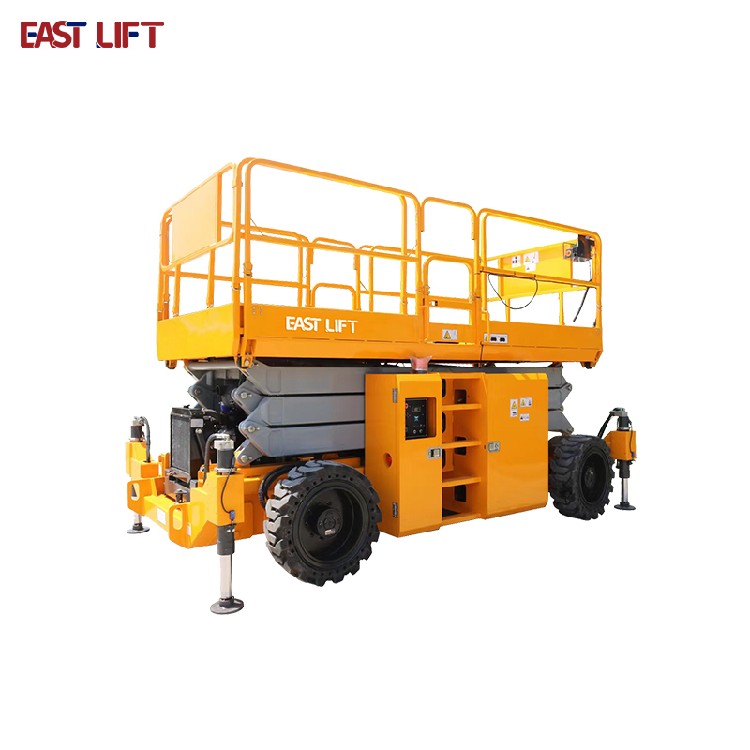
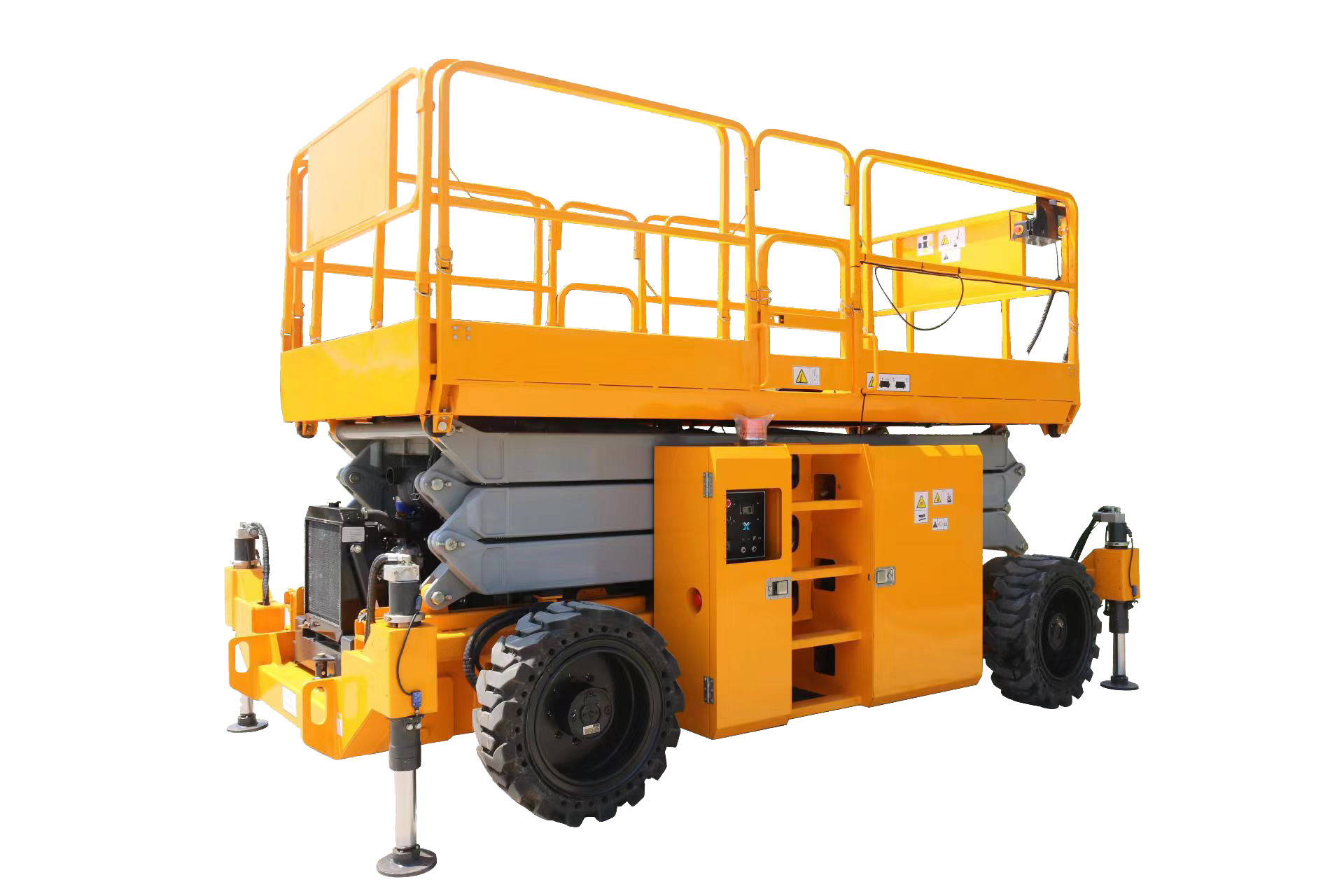
2. Four Sets of Hydraulic Self-Leveling Outriggers (Exclusive Core Safety Feature for Rough Terrain Models)
Four independent heavy-duty telescopic hydraulic outriggers, each equipped with a pressure sensor, enable one-touch automatic leveling to adapt to slopes within 3°.
Mandatory electrical interlock protection: lifting and driving functions are fully locked if outriggers are not fully extended or fail to bear ground load, eliminating overturn risks from unsupported aerial operation.
Thickened anti-slip steel base plates are installed at the bottom of each outrigger to disperse ground pressure and prevent sinking and side tipping on soft soil. Each outrigger cylinder integrates a hydraulic lock to avoid automatic retraction even if oil pipes rupture.
3. Tilt Angle Safety Protection System
High-precision tilt sensors continuously monitor the vehicle’s horizontal level, with a standard safety threshold of 3°.
- Mild tilt condition: Continuous audible and visual alarms plus flashing warning lights activate.
- Excessive tilt condition: Only platform descent is permitted; lifting and travel movements are fully cut off. The platform must lower to ground level and the vehicle re-leveled before normal operation resumes.
Tilt protection takes top priority when the platform is elevated. Travel speed is automatically restricted during aerial operation on bumpy ground, while lifting functions are disabled at high travel speeds.
4. Pothole Protection Guards (Anti-Chassis Collapse Design)
Swingable mechanical pothole guards are mounted on both sides of the chassis. They swing down automatically to support the chassis when crossing ditches and depressions, preventing wheel sinkage and vehicle overturning — a configuration absent on indoor scissor lifts.
5. Travel Braking Safety
Equipped with hydraulic multi-disc wet service brakes and spring-applied parking brakes. The parking brake engages automatically upon engine shutdown to stop rolling on slopes.
Proportional travel speed limiting: Travel speed reduces automatically once the platform is raised, drastically lowering overturn risks during aerial movement.
II. Scissor Lifting Load-Bearing Safety Structures (Shock-Resistant Load Bearing)
Thickened High-Strength Manganese Steel Scissor Arms
Constructed from large-section rectangular manganese steel tubes with wall thickness over 6mm, reinforced with enlarged pins and double side plates to withstand dynamic vibration and impact on construction sites, achieving a structural safety factor of ≥2.5. Self-lubricating wear-resistant bushings are fitted at all multi-layer scissor hinge points to avoid fatigue cracking, deformation and instability caused by continuous bumping.
Synchronized Dual Lifting Cylinder Assembly
Symmetric left and right lifting cylinders paired with a synchronized hydraulic circuit prevent platform tilting from unbalanced unilateral load. Each cylinder integrates an explosion-proof counterbalance valve (load holding valve), a mandatory anti-fall component.
Mechanical Safety Latch Locking Mechanism
Multi-stage safety spring latches are installed alongside the scissor arms. In cases of hydraulic failure or oil pipe rupture, springs eject the latches to clamp the scissor arms mechanically and lock the platform in place, providing dual backup protection against free fall.
III. Multi-Layer Hydraulic Anti-Fall Safety Systems (Backup Protection for Equipment Malfunctions)
Explosion-Proof Counterbalance Valves on Lifting Cylinders (Primary Passive Anti-Fall Device)
An integrated explosion-proof valve is installed at the port of each lifting cylinder. It instantly seals the oil chamber if pipes rupture or hydraulic pressure is lost, limiting platform drop distance to ≤25mm to prevent rapid free fall.
Manual Emergency Lowering Valve (Self-Rescue During Power Failure)
If the diesel engine stalls or the hydraulic pump malfunctions, operators can slowly and steadily lower the platform by manually turning the pressure relief valve — no external power supply is required for field self-rescue. High-end models come with an auxiliary manual hydraulic pump.
System Overflow & Overpressure Protection
A relief valve is built into the main hydraulic circuit to automatically release pressure under overload or pipeline blockage, preventing high-pressure pipe bursts. Hydraulic lines use tear-resistant flame-retardant high-pressure hoses reinforced with metal hard pipes to resist damage from gravel impact on construction sites.
Independent Hydraulic Locks for Outriggers
Every outrigger cylinder is fitted with an individual hydraulic lock that prevents outrigger retraction when pipelines are damaged, permanently securing the supporting structure.
IV. Electrical Intelligent Interlock & Active Safety Control
Redundant Dual Emergency Stop Circuits
One red emergency stop button is fitted on the platform control box and another at the chassis engine compartment. Activating either cuts off diesel fuel supply and all hydraulic movements. The two circuits operate on independent power supplies to retain functionality if one circuit fails.
Full-Process Safety Interlocks (Prevent Misoperation)
- If guardrail gate is not fully closed: Lifting and travel functions locked
- If outriggers fail to contact ground: Lifting prohibited
- If vehicle tilt exceeds threshold: Lifting and fast travel disabled
- If load exceeds rated capacity: Lifting cut off, only descent allowed
Overload Weighing Sensor System
Pressure sensors installed beneath the platform detect loads exceeding 110% of the rated capacity, triggering audible and visual alarms and disabling upward lifting to avoid overturning from overweight loads.
CAN Bus Fault Self-Diagnosis
Real-time monitoring of tilt angle, outrigger pressure, hydraulic pressure and engine operating conditions. Fault codes are displayed to alert operators to potential structural and hydraulic hazards in advance. A 3-second audible and visual warning activates before all lifting and travel movements to warn surrounding personnel.
High-Voltage Grounding Protection
The entire metal frame of the machine is reliably grounded to dissipate static electricity during thunderstorms or accidental contact with overhead power lines, mitigating electric shock risks.
V. Operator Platform Personal Protection Structures (Anti-Fall & Anti-Squeeze)
Fully Enclosed High-Strength Safety Guardrails
Guardrails stand at a minimum height of 1100mm with double horizontal crossbars and bottom kick plates using thickened steel tubing. Self-closing safety gates on both sides lock all machine functions if unlatched. Guardrails are foldable to reduce overall width for transportation.
Anti-Slip & Anti-Puncture Platform Deck
Textured anti-slip steel plate with raised edge barriers prevents slipping and falling of operators or tools. An optional infrared anti-pinch light curtain automatically halts machine movement if personnel or objects enter the scissor lifting channel.
Bilateral Extendable Platform Decks
Front and rear platform extensions expand the working range, fitted with limit locks that only permit lifting once extensions are fully locked into position, preventing center-of-gravity shift and overturning from unilateral overhang.
Safety Anchor Points for Harness Lanyards
Dedicated anchor points are integrated into the platform for secure attachment of safety harnesses (harnesses must never be fixed to guardrails). Built-in tool storage troughs avoid uneven weight distribution from loose heavy tools.
VI. Diesel Power System Exclusive Safety Structures (Outdoor Fire Prevention & Fault Resistance)
Engine Shutdown Protection Mechanism
The system automatically reduces engine power if engine oil pressure is too low or coolant temperature spikes. Severe faults trigger full fuel cut-off shutdown to avoid engine blowouts, oil leaks and subsequent fire hazards.
Fuel Circuit Fire Prevention Design
The diesel fuel tank is equipped with an explosion-proof breather valve; all fuel lines are wrapped in flame-retardant sleeves, and heat insulation partitions separate high-temperature engine components from fuel pipelines, minimizing fire risks from gravel impact and fuel leakage on open-air job sites.
Slide-Out & Tiltable Engine Compartment
A drawer-style engine frame mounted on the machine side enables maintenance without chassis jacking, lowering safety risks during servicing. Engine glow plugs support reliable cold-start operation in low-temperature construction environments, preventing operators from being stranded at height due to startup failures.
Engine Speed-Linked Hydraulic Protection
Hydraulic flow output is restricted at low engine idle speed to eliminate platform shaking and instability caused by insufficient hydraulic pressure during lifting.
Core Summary of Safety Structural Advantages of Diesel Rough Terrain Scissor Lifts (Key Differences from Indoor Electric Scissor Lifts)
- Upgraded stability system: Four-wheel drive with floating rear axle, solid off-road tires, self-leveling outriggers and multi-stage tilt protection for safe operation on slopes and soft ground
- Shock-resistant structural design: Thickened manganese steel scissor arms, enlarged hinge pins and mechanical safety latches withstand continuous dynamic vibration on construction sites
- Field self-rescue capability: Independent diesel power source paired with manual emergency lowering valve enables platform descent without external power supply
- Multi-layer overturn prevention barriers: Outrigger interlocks, tilt-based speed limitation, overload lifting lockout and pothole guards create multiple safeguards against aerial side tipping
- Outdoor fire safety configuration: Heat-insulated engine compartments, flame-retardant hydraulic pipelines and engine overheat protection adapt the unit to harsh open-air construction environments