EASTLIFT
Product description
Personal Protection Core Features of Diesel Rough-Terrain Scissor Lifts
Diesel rough-terrain (RT) scissor lifts are mainly used in construction sites with muddy ground, steep slopes, pits and other rugged outdoor conditions. Their protection systems fall into six categories: platform enclosure fall protection, anti-overturn stability protection for the whole machine, safety protection against hydraulic/power failure, intelligent sensor early warning protection, special safety features for diesel power units, and supporting personal protective equipment for operators. Compared with indoor electric scissor lifts, they feature enhanced anti-tip-over performance for uneven terrain, anti-slip designs for muddy surfaces and redundant emergency safety systems for outdoor operations.
I. Platform Enclosure Fall Protection (Direct Protection for Operators on the Platform)
Heightened Enclosed Safety Guardrails
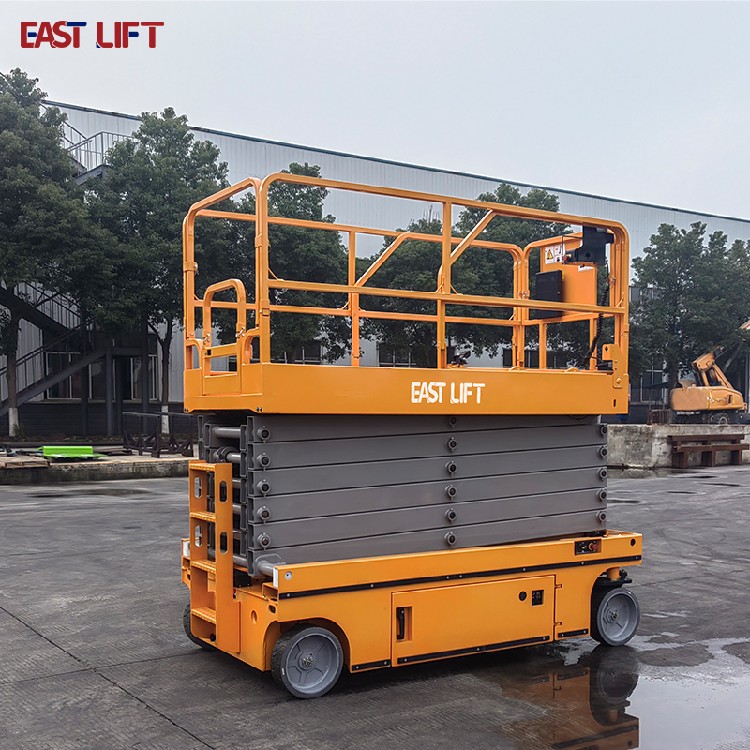
Guardrails stand at a minimum height of 1050 mm, fitted with double horizontal rails and a 150 mm high toe board at the bottom to prevent tools or operators’ feet from sliding out. The guardrails slightly incline inward, so operators will rebound inward upon impact instead of falling off. The sliding platform gate is equipped with an automatic locking mechanism; lifting functions are disabled once the gate is open, eliminating fall risks caused by lifting with an unlatched gate.
Dedicated Anchor Points for Safety Harnesses
Load-bearing anchor points complying with national standards are installed on both sides of the platform. Operators shall use twin-lanyard safety harnesses following the "high attachment, low use" principle, and harnesses must never be fastened to ordinary guardrails, meeting the fall protection needs of multiple simultaneous operators.
Full Anti-Slip Pattern Platform Floor
The floor is made of thick steel plates with diamond anti-slip patterns to greatly reduce slipping risks under muddy, oily or rainy site conditions. The extended auxiliary platform is fully covered with the same anti-slip plates for complete slip resistance across all standing areas for multiple workers.
Pinch Prevention for Scissor Clearances
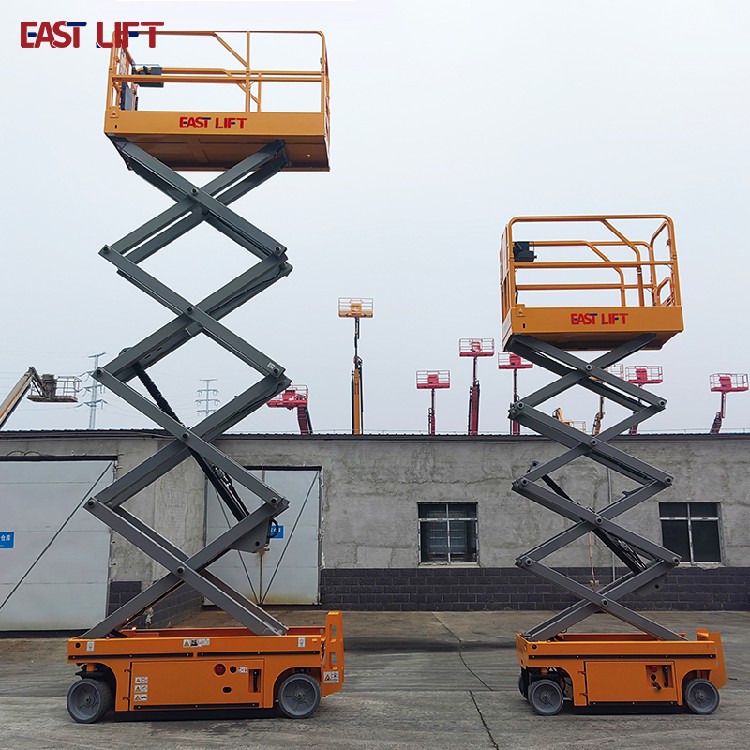
Soft sensor strips are mounted on the inner sides of scissor arms. The machine immediately stops and retracts upward if limbs or materials get pinched during lifting to avoid crush injuries. A mechanical safety support rod is built into the scissor assembly to lock the structure during maintenance, preventing sudden descent and crush hazards.
II. Exclusive Chassis Anti-Overturn Stability Protection for Rough Terrain (Core Outdoor Safety Feature Unique to Diesel RT Models)
Tailored for construction sites with slopes, soft soil and uneven ground, this suite of anti-tip systems is not available on indoor electric scissor lifts:
High-Precision Inclination Monitoring System
Chassis tilt sensors constantly monitor horizontal balance, with a typical safety threshold of 3 degrees. When the tilt angle exceeds the limit, an audible and visual alarm activates; lifting and driving functions are locked, and only descent is permitted to force the machine back to a safe gradient and eliminate rollover risks during elevated operation. The control panel displays real-time tilt angles for operators to assess ground flatness.
Telescopic Hydraulic Outriggers with One-Touch Leveling
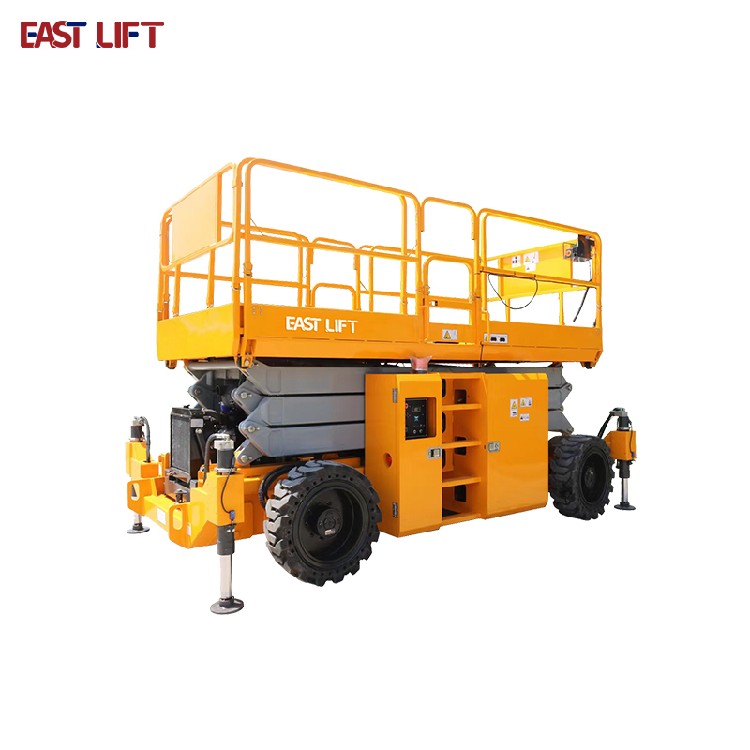
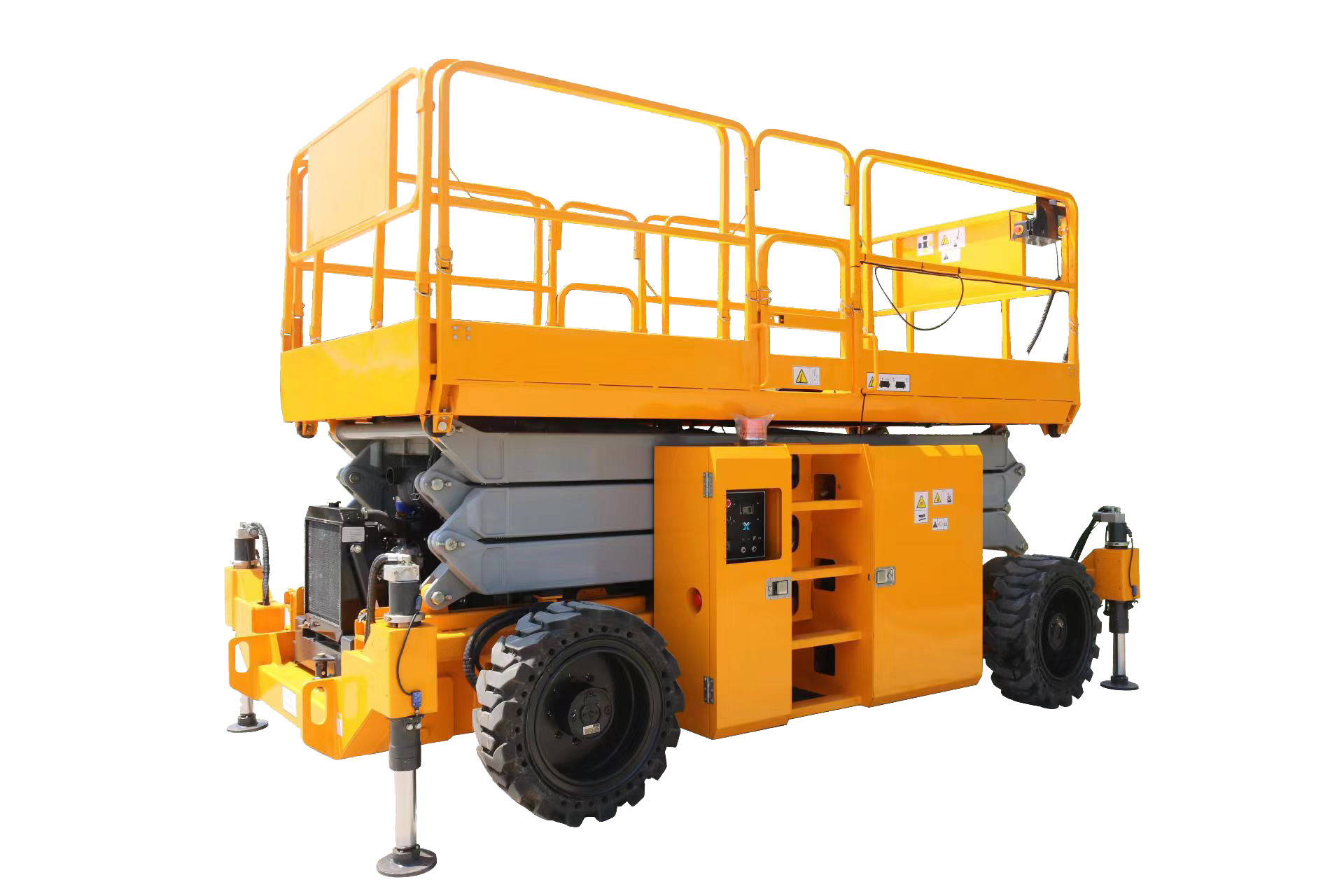
Four independent outriggers widen the support footprint significantly on soft mud to boost stabilizing torque. Outrigger position sensors disable all lifting functions if any outrigger fails to fully contact the ground or hangs suspended. Self-leveling hydraulic cylinders compensate for uneven ground to keep the chassis horizontal, fundamentally lowering overturn hazards.
Four-Wheel Drive & Oscillating Floating Axle Stabilization Structure
The rough-terrain floating axle maintains full four-wheel contact with the ground when crossing pits and slopes to reduce single-point chassis suspension. Travel functions lock automatically when the platform rises more than 10 cm off the ground, prohibiting high-speed driving at height to avoid center-of-gravity shifts and rollovers. A mechanical parking brake engages automatically on shutdown to prevent sliding on gradients.
Wind Speed Safety Limitation
The electric control system integrates wind load protection logic: maximum lifting height is restricted under strong wind conditions at height, and the platform is forced to lower once wind speed exceeds the threshold to prevent the unit from being blown over and injuring personnel.
III. Redundant Safety Protection Against Hydraulic Failure (Prevents Rapid Descent from Pipe Bursts or Pressure Loss)
Hydraulic Burst Valves Built into Lifting Cylinders
Locking anti-burst valves are mounted directly on lift cylinders. They instantaneously seal the cylinder if hydraulic pipes rupture or fluid leaks, stopping uncontrolled free fall and enabling slow, controlled descent to avoid severe injuries from high-speed platform dropping.
Manual Emergency Descent Mechanism
If the diesel engine stalls, the hydraulic pump malfunctions or full power loss occurs, a mechanical manual pressure relief lever on the platform control box enables slow lowering without power for trapped operators to exit safely. A secondary emergency descent valve is also fitted on the chassis for ground personnel to lower the platform remotely.
Hydraulic Overload Relief Protection
Pressure relief valves are installed in the lifting oil circuit to automatically release excess pressure when lifting resistance exceeds limits, preventing scissor frame deformation or fracture that could harm operators.
IV. Multi-Layer Electric Control Early Warning & Emergency Stop Protection
Dual Red Mushroom Emergency Stop Buttons
One emergency stop button is fitted on the platform operator control box and a second on the ground chassis controller. Pressing either immediately cuts power to the diesel engine, hydraulic system and drive system, engages mechanical brakes, and cannot reset automatically—manual unlocking is required to resume operation, enabling full machine shutdown in one touch during sudden hazards.
Overload Weight Sensing Protection
Pressure sensors under the platform trigger audible and visual alarms when the total load exceeds 105% of the rated capacity, locking all upward lifting movement and only allowing descent. This eliminates structural breakage and falling risks caused by overloading with personnel and materials, enforcing load limits for multi-worker operations.
Upper/Lower Travel Limit Switches & Anti-Collision Over-Travel Protection
Mechanical limit switches define the maximum and minimum lifting positions of the scissor arms. Ultrasonic radar sensors on the top detect overhead obstacles and halt lifting automatically to prevent crushing injuries from impact with roof structures or steel frames. Side-mounted collision sensors trigger speed reduction or full shutdown when approaching walls.
Full-Machine Audible & Visual Warning System
A buzzer and rotating warning light activate automatically during lifting and travel. High-brightness warning signals improve visibility at night construction sites to alert ground staff and avoid platform collisions that may cause operators to fall.
V. Exclusive Personal Safety Features for Diesel-Powered Units (Not Equipped on Electric Scissor Lifts)
Engine Fire & Heat Insulation Protection
High-temperature exhaust manifolds and turbochargers of the diesel engine are fully wrapped in heat-resistant shielding to prevent scald injuries from accidental contact. Fire barrier layers around the engine compartment mitigate ignition risks on sites with flammable debris.
Exhaust Diversion & Noise Reduction Design
Extended exhaust pipes direct emissions sideways or downward to prevent operators at height from inhaling diesel fumes. The entire machine is lined with sound-absorbing insulation to reduce long-term high-decibel noise exposure and hearing damage.
Explosion-Proof Fuel Line Design
High-pressure corrosion-resistant fuel hoses with double-sealed joints eliminate fuel leakage and fire hazards from vibration over rough terrain. The fuel tank is fitted with an overflow valve to prevent spillage during refueling.
Automatic Engine Shutdown on Malfunction
The engine cuts out automatically if oil pressure drops too low or coolant temperature rises excessively, avoiding engine knocking and scald injuries from spraying high-temperature hydraulic fluid.
VI. Mandatory Supporting Personal Protective Equipment (Dual Safeguard: Machine Protection + Operator PPE)
- Operators on the platform must wear national standard twin-lanyard safety harnesses anchored to the dedicated platform attachment points;
- Safety helmets are required to protect against impact from falling overhead construction debris;
- Anti-slip and puncture-resistant safety boots shall be worn to suit muddy steel platform surfaces;
- Earmuffs are mandatory for high-noise working conditions; dust masks must be used in dusty construction environments.